The Stablecoin Safety Myth: What the Numbers Actually Say About Yield vs. Bitcoin Accumulation
The Appeal of Earning Nothing Dangerous
Stablecoins have become the default parking lot for American crypto capital. The pitch is straightforward: earn 4% to 5% annually on USDC or USDT, sidestep Bitcoin's volatility, and wait for a clearer entry point. For investors who lived through 2022's drawdowns, the psychological appeal of a dollar-pegged balance generating yield is considerable.
But appealing and mathematically sound are different categories. When the actual numbers behind stablecoin yield strategies are examined alongside Bitcoin's historical accumulation profile — and when US tax treatment and inflation are factored in — the case for stablecoin parking weakens substantially. In some scenarios, it inverts entirely.
What 5% APY Actually Delivers After Tax
Stablecoin yield earned through lending protocols, centralized platforms, or money market products is treated by the IRS as ordinary income. For most American investors in the middle and upper-middle income brackets, that means an effective federal rate of 22% to 37%, before state income taxes are applied.
A California resident earning 5% APY on a $100,000 stablecoin position, subject to a combined federal and state marginal rate of approximately 46%, nets roughly 2.7% after taxes. On $100,000, that is $2,700 in after-tax yield for the year.
For context, the Consumer Price Index has averaged above 3% annually over the three-year period ending in 2024. Real purchasing power, after taxes and inflation, on a nominally 5% stablecoin yield position has been negative or marginally positive at best for a significant portion of the American investor base.
This is not a fringe outcome. It is the arithmetic reality for a substantial share of the crypto-holding population in high-tax states including California, New York, New Jersey, and Illinois.
The Opportunity Cost That Spreadsheets Omit
The more consequential number is the one that never appears on a yield dashboard: what Bitcoin did while the capital sat in stablecoins.
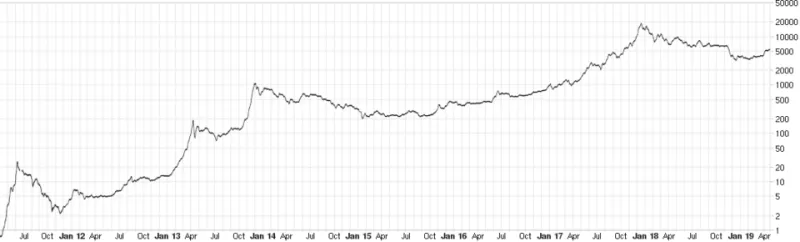
Bitcoin's compound annual growth rate over the five-year period from 2019 through 2024 exceeded 40% on an annualized basis, though with extreme variance across individual years. Even stripping out the outlier performance years and focusing on accumulation-phase entry points — periods when Bitcoin traded in established consolidation ranges following major drawdowns — the asset's appreciation substantially outpaced stablecoin yields across most comparable windows.
Consider an investor who moved $50,000 into a stablecoin position yielding 5% APY in January 2023, intending to wait for a better Bitcoin entry. Over the following twelve months, Bitcoin appreciated approximately 155%. After taxes on the stablecoin yield, that investor earned roughly $1,350 in real after-tax yield while forgoing exposure to an asset that more than doubled.
The counterargument — that the investor could not have known Bitcoin would perform that way — is correct but incomplete. The same uncertainty applies to the stablecoin strategy. The investor who parks in stablecoins is not avoiding risk. They are accepting a different risk profile: the near-certainty of modest, tax-eroded yield against the possibility of significant missed appreciation during an accumulation phase.
Dollar-Cost Averaging vs. Yield Accumulation: A Structural Comparison
A more rigorous comparison examines not single-year windows but systematic accumulation behavior across full market cycles.
An American investor who deployed $500 per month into Bitcoin from January 2020 through December 2023 — spanning a full cycle including the 2021 peak and the 2022 bear market — ended the period with a position valued substantially above total capital deployed, even accounting for the drawdown period. The dollar-cost averaging approach removed the need to time entry points precisely and captured the recovery from cycle lows automatically.
A parallel investor who parked equivalent monthly contributions into a 5% APY stablecoin vehicle over the same period, intending to deploy at a better moment, faced compounding decision paralysis. The psychological literature on investing is unambiguous on this point: investors who move to cash or cash-equivalents while waiting for better entry conditions systematically underperform those who maintain consistent accumulation, because the decision to re-enter is perpetually deferred.
The stablecoin yield did not compensate for the timing error. It made the timing error more comfortable to sustain.
Tax Structure Differences That Compound Over Time
Beyond the annual yield calculation, the tax treatment of long-term Bitcoin appreciation creates a structural advantage that stablecoin yield cannot replicate.
Bitcoin held for more than twelve months qualifies for long-term capital gains treatment under current US tax law. For most middle-income investors, the federal long-term rate is 15%, compared to ordinary income rates of 22% to 37% applied to stablecoin yield. High earners face a 20% long-term rate plus the 3.8% net investment income tax — still substantially below the marginal ordinary income rates applied to yield income.
This differential compounds meaningfully over multi-year holding periods. An investor accumulating Bitcoin across a full four-year cycle and realizing gains under long-term treatment retains a materially larger share of appreciation than an investor paying ordinary income rates annually on stablecoin yield. The tax efficiency of unrealized appreciation — where no tax event occurs until the asset is sold — represents a structural advantage that yield-bearing instruments cannot offer.
When Stablecoins Make Sense
This analysis does not argue that stablecoins serve no legitimate function in a crypto portfolio. For short-term operational reserves, for investors with specific near-term liquidity requirements, or as a tactical tool during periods of demonstrably elevated systemic risk, dollar-denominated positions carry genuine utility.
The problem is not the instrument. It is the framing. Stablecoins marketed and perceived as a safe alternative to Bitcoin accumulation obscure the real trade-off: a modest, tax-inefficient yield exchanged for exposure to an asset with a demonstrated long-term appreciation profile.
For American investors with multi-year time horizons, the question worth asking is not whether 5% APY is better than 0%. It is whether 5% gross — approximately 2.5% to 3% after taxes and inflation — justifies the opportunity cost of sitting outside an asset that has compounded at multiples of that rate across every full cycle in its history.
The math does not make that case. The comfort of a stable balance does — and comfort has historically been an expensive luxury in Bitcoin markets.